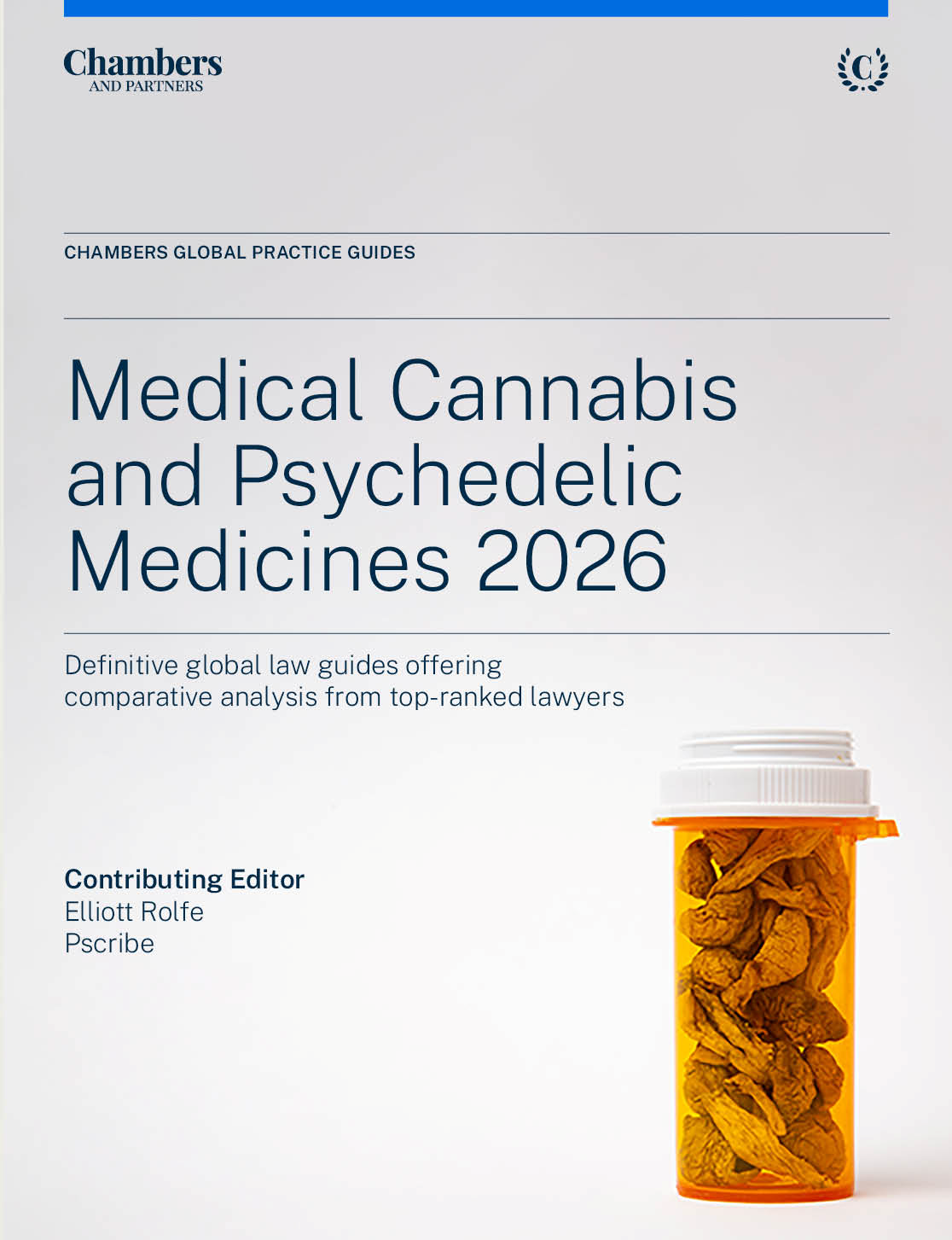
Medical Cannabis & Psychedelic Medicines 2026
The new Medical Cannabis & Psychedelic Medicines 2026 guide provides the latest legal information on the primary laws and regulations affecting these products, the relevant regulatory authorities, companies’ legal risks, cross-jurisdictional issues, legal elements affecting access to medical cannabis and psychedelic medicines, their use in novel food and wellness products, and decriminalisation and adult use regulation.
Last Updated: May 28, 2026
Compare law and practice by selecting locations and topic(s)
Select Locations

Select Topic(s)
Please select at least one location and one topic to use the compare functionality.
Authors


Pscribe is a specialist group of lawyers focused on life sciences and healthcare in the emerging psychoactive medicines sectors. Headquartered in London, it provides strategic, legal and regulatory advice to medical cannabis cultivators, clinics, importers, distributors, investors and other key supply chain participants navigating the complex legal frameworks that govern these novel therapies and controlled substances. The team behind Pscribe set up the UK’s first dedicated medical cannabis and psychedelic medicines legal team over five years ago, to provide cutting-edge regulatory advice and services for the medicinal cannabis, CBD and psychedelic medicines industries. Clients range from start-ups to multinationals scaling in or into the UK and Europe, and Pscribe advises on the full commercial and regulatory life cycle – from licence applications and product/service compliance to importation and exportation, distribution, labelling, commercial agreements and regulatory solutions. With unmatched sector insight, deep regulatory knowledge and commercial pragmatism, Pscribe helps clients lead responsibly in a tightly regulated and rapidly evolving space. The firm is known for its precision, relatable authenticity, and ability to simplify complexity without sacrificing rigour.
Global Overview: Medical Cannabis and Psychedelic Medicines
For most of the past sixty years, medical cannabis and psychedelic compounds have publicly shared little more than a place near the top of international drug control schedules. In 2026, they share something more substantive: a moment of political, regulatory and commercial inflection that justifies, for the first time, combining the Chambers practice guides to each into a single volume. Both have spent the first quarter of the 21st century being painstakingly reintroduced into legitimate medicine; this has occurred sometimes through clinical trials, sometimes through political reform, often despite the regulatory architecture built to keep them out. The chapters that follow cover France, Germany, Switzerland and the United Kingdom at a moment when that architecture is, in different ways and at different paces, finally giving way. There is a broad range of compounds that fall into the category of psychedelic, and novel compounds are being actively researched commercially for their clinical potential, but for the most part the focus of contemporary developments is on psilocybin, MDMA, iboga/ibogaine, and proprietary analogues of these and other “classic” psychedelics.
Convergent substances, divergent markets
Although it is tempting to bracket cannabis and psychedelic medicines together, and there are instances of investors, clinicians and policymakers doing so, the two sectors differ markedly in maturity. Medical cannabis is a global market worth several billion euros annually, with multiple licensed products, established prescribing networks across much of Europe and a vocal patient community. Psychedelic medicines, by contrast, remain at the threshold of approval. Ketamine-derived esketamine (Spravato) is still the only psychedelic-adjacent product to hold a regulatory marketing authorisation, and what is called the “psychedelic market” in 2026 is still principally a market in drug developers and access programmes rather than in widely prescribed medicines.
Despite the asymmetry, the two sectors face a strikingly similar regulatory architecture. Both contend with international scheduling under the 1961 Single Convention on Narcotic Drugs and the 1971 Convention on Psychotropic Substances; both navigate national controlled drugs regimes that were drafted in an era when “medical use” was a contemplated exception rather than a meaningful pathway (the UK’s Misuse of Drugs Act, Germany’s Betäubungsmittelgesetz, the French Code de la santé publique, the Swiss Narcotics Act, the US Controlled Substances Act); and both are now being asked the same questions: how to schedule substances whose medical promise has outgrown their original classification, how to license access in the absence of fully licensed products, and how to draw a workable line between medicine, wellness and recreation.
Medical cannabis: reform tested, reform sustained
Of the four jurisdictions covered in this year’s guide, Germany has become the European reference market. The Cannabis Act (CanG), in force since April 2024, has restructured both the recreational and medical sides simultaneously. The medical market, buoyed by the contemporaneous relaxation of the Betäubungsmittelgesetz regime in respect of medical cannabis, has roughly tripled in volume since 2024, making Germany comfortably the largest medical cannabis market in Europe.
The first EKOCAN interim report was published in September 2025 and the second on 1 April 2026. Far from closing the debate, the second report was used by the federal government to justify targeted tightening, particularly in relation to youth protection, organised crime and the online medical-cannabis market.
The new CDU/CSU–SPD coalition has signalled that telemedicine prescribing and certain Social Club provisions will be tightened, and the commercial retail pilot, which is Pillar 2 of the reform, remains under development, with Berlin, Hamburg and Munich likely early movers.
France has approached a similar destination by a more cautious route. The generalisation of medical cannabis under the framework set out in Law No 2023-1250, originally expected to take effect on 1 January 2025, has been postponed repeatedly through a combination of political instability and the procedural demands of EU notification. Three implementing decrees were submitted to the European Commission under the TRIS procedure in March 2025, the Haute Autorité de Santé (HAS) has been preparing the evaluation framework for reimbursement, but the timing of the permanent regime remains dependent on the implementing texts and the final HAS process, and the pilot programme has again been extended to ensure continuity of care for enrolled patients. When the permanent regime arrives, currently expected at some point in 2026, it will be tightly pharmaceuticalised: training-certified specialist prescribers, five last-resort indications, oral/sublingual forms and sealed-capsule flower delivered through approved vaporisation devices, and a domestic cultivation industry integrated into the existing pharmaceutical regulatory architecture rather than constituted as a separate cannabis sector.
Switzerland continues to occupy a category of its own. Federal pilot trials authorised under amendments to the Narcotics Act have multiplied since 2023, with seven active programmes in Zürich, Basel, Lausanne, Geneva, Bern, Lucerne and Biel/Bienne testing different distribution models including pharmacies, non-profit clubs and dedicated retail outlets. In parallel, the National Council’s Social Security and Health Committee in 2025 advanced pre-legislative drafting toward a nationwide regulated adult-use market, with a state-monopoly retail model now the most likely federal landing zone. Switzerland may therefore become the first European jurisdiction to move from a pilot exemption toward a nationwide regulated adult-use framework, but the model currently under discussion is not a fully commercial market: it combines licensed production with state-monopoly, non-profit retail distribution.
The United Kingdom presents the most pronounced divergence between regulatory permission and practical access. Cannabis-based products for medicinal use (CBPMs) have been prescribable by specialist physicians since November 2018, but there remain only a handful of NHS prescriptions, while the private sector now serves in the region of 100,000 patients through a market valued in the hundreds of millions of pounds and seeing 10% year-on-year growth. The Advisory Council on the Misuse of Drugs (AMCD) was commissioned in June 2025 to review whether the 2018 rescheduling has met its objectives and, in a noteworthy expansion of scope, to consider how those findings might inform policy on other controlled substances, psilocybin in particular. The Labour government has indicated no appetite for broader cannabis reform, but the ACMD review will set the terms of the next significant UK policy moment for both sectors.
Psychedelic medicines: the threshold year
The psychedelic side of the guide will be read in the shadow of three developments. The first is Compass Pathways’ achievement of statistically significant primary endpoints in both pivotal Phase 3 trials of synthetic psilocybin (COMP360) for treatment-resistant depression: COMP005 reported out in June 2025, COMP006 in February 2026. With a New Drug Application expected to be submitted to the Food and Drug Administration (FDA) in the final quarter of 2026, the first regulatory approval of a classic psychedelic medicine is now a genuine prospect, with consequences that will extend well beyond the United States.
The second is the corresponding setback to MDMA-assisted therapy. Lykos Therapeutics, now operating as Resilient Pharmaceuticals after a reported workforce reduction of approximately 75%, continues to chart a route to resubmission. The FDA’s Complete Response Letter declining to approve then-Lykos’ New Drug Application (issued in August 2024 and made public in September 2025 as part of a wider FDA transparency initiative) leaves no doubt that an additional Phase 3 trial will be required to address durability, safety reporting and bias concerns. The MDMA story is not over, but the prospect of MDMA-assisted therapy being the first approved psychedelic treatment in the United States has given way to a more cautious timeline.
The third, and from a regulatory standpoint perhaps the most consequential, is the US Executive Order of 18 April 2026, “Accelerating Medical Treatments for Serious Mental Illness”. The Order directs the FDA Commissioner to make Commissioner’s National Priority Vouchers available to Breakthrough-designated psychedelic drugs, instructs the FDA and Drug Enforcement Administration (DEA) to establish a joint pathway for eligible patients to access investigational psychedelics under the Right to Try Act, commits the US Department of Health and Human Services (HHS) to allocate at least USD50 million from existing funds to support and partner with state governments, and directs the Attorney General to initiate scheduling reviews upon successful completion of Phase 3 trials. The FDA has been quick to take action – just six days after the Order, the FDA issued the first three vouchers: these were awarded to Compass Pathways’ COMP360, the Usona Institute’s psilocybin for major depressive disorder, and Transcend Therapeutics’ methylone for PTSD. The third allocation came as a surprise to many observers, who had expected the voucher to go to Resilient Pharmaceuticals’ MDMA programme.
Europe is moving more incrementally but in unmistakably the same direction. Switzerland’s limited medical use programme, administered under the Federal Office of Public Health since 2014, issued 723 patient authorisations during 2024 for psilocybin, MDMA and LSD, with roughly 1,660 individual treatments delivered by approximately 100 authorised physicians, a quietly remarkable record for a small jurisdiction operating without a single marketed product. In July 2025, Germany’s Federal Institute for Drugs and Medical Devices (BfArM) approved Europe’s first compassionate-use psilocybin programme, run by the Central Institute of Mental Health (CIMH) in Mannheim and limited to 50 patients in its first year. France has no equivalent framework in place, but a pivot toward psychedelic research is increasingly under public discussion. The UK, although it has not yet acted, has formally opened a regulatory conversation about psilocybin through the ACMD review referenced above.
Non-controlled cannabinoids and the cautionary tale of CBD
Alongside the controlled medical sector, every European jurisdiction continues to grapple with the parallel market in non-controlled cannabinoids (principally cannabidiol) sold as wellness products, supplements, foods or cosmetics. The European Food Safety Authority (EFSA) released an updated novel food statement on 9 February 2026, which set, for the first time, a provisional safe intake level for CBD: 0.0275 milligrams per kilogram of body weight per day, equivalent to approximately 2 milligrams for a 70 kg adult. EFSA derived the figure by applying a 400-fold uncertainty factor to address data gaps that have remained unresolved since its 2022 statement, and for adults under 25, pregnant or lactating women, and those on medication, no safe level could be established at all. No CBD product is yet authorised as a novel food in the European Union, and a separate proposal from France’s public health agency (Agence nationale de sécurité sanitaire de l'alimentation, de l'environnement et du travail, ANSES) to classify CBD as a presumed reproductive toxicant under the EU’s regulation on the classification, labelling, and packaging of chemical substances (the “CLP Regulation”) remains under consideration. The European Chemicals Agency’s Risk Assessment Committee has since recommended EU-wide harmonised classification of cannabidiol as a reproductive toxicant. The contrast with Australia’s 150 milligram daily limit for CBD therapeutic products is stark, and the divergence between Europe’s exhaustively cautious posture and the booming consumer market in CBD products illustrates how scheduling and safety regimes drafted for one purpose can constrain industries that have grown up in their interstices.
The year ahead
What unites the cannabis and psychedelic stories in 2026 is that both have outgrown the binary debate about legalisation and are now properly within the territory of regulatory design. For cannabis, the questions are no longer whether to permit medical use but how to make it deliverable: prescriber training, telemedicine controls, cross-border recognition of prescriptions, pharmacovigilance, reimbursement, and the long-deferred question of whether and how to extend the medical architecture to adult use. For psychedelics, the questions are how to approve substances whose therapeutic effect has historically been bundled with intensive psychotherapy, how to expand access to investigational products without compromising the integrity of clinical trials, and how to reschedule efficiently once approval has been granted.
A few cross-jurisdictional themes will recur through the chapters that follow. Cross-border prescribing, particularly the question of whether prescriptions issued in one EU jurisdiction must be honoured in another, has become a flashpoint in Germany and is being watched closely in France. The role of telemedicine, central to the rapid scaling of medical cannabis prescribing in Germany and the UK, faces tightening on both sides of the Channel. The compassionate use route, pioneered in Switzerland for psychedelics and now extended in Germany, is acquiring the contours of a Europe-wide framework for pre-approval access. And the integration of psychotherapy into psychedelic medicine, a feature with no precise analogue in cannabis, continues to test the boundaries of what regulators are willing to call, and pay for as, medicine.
Three years ago, this guide existed only as a medical cannabis volume. Two years ago we added psychedelics as a standalone publication. In 2026, the two have merged. The jurisdictional chapters that follow set out, in our authors’ detailed view, the most consequential snapshot to date of a generational regulatory transition still in motion.
Authors
Pscribe is a specialist group of lawyers focused on life sciences and healthcare in the emerging psychoactive medicines sectors. Headquartered in London, it provides strategic, legal and regulatory advice to medical cannabis cultivators, clinics, importers, distributors, investors and other key supply chain participants navigating the complex legal frameworks that govern these novel therapies and controlled substances. The team behind Pscribe set up the UK’s first dedicated medical cannabis and psychedelic medicines legal team over five years ago, to provide cutting-edge regulatory advice and services for the medicinal cannabis, CBD and psychedelic medicines industries. Clients range from start-ups to multinationals scaling in or into the UK and Europe, and Pscribe advises on the full commercial and regulatory life cycle – from licence applications and product/service compliance to importation and exportation, distribution, labelling, commercial agreements and regulatory solutions. With unmatched sector insight, deep regulatory knowledge and commercial pragmatism, Pscribe helps clients lead responsibly in a tightly regulated and rapidly evolving space. The firm is known for its precision, relatable authenticity, and ability to simplify complexity without sacrificing rigour.